
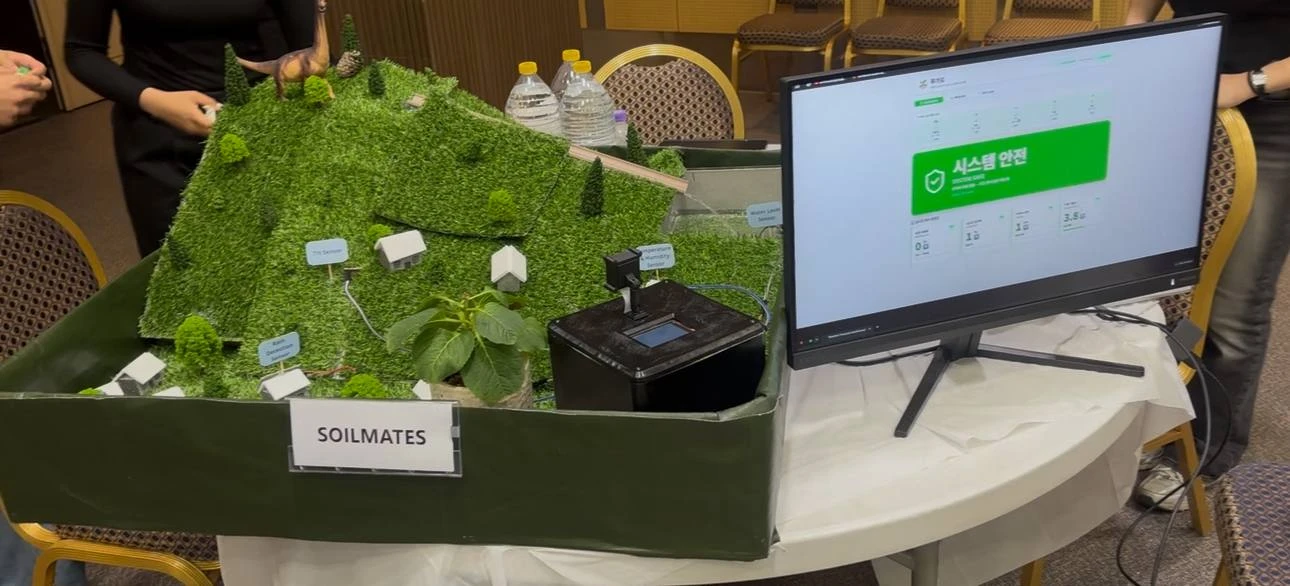
01 The problem
Landslides hit small farms first
Every monsoon season, rural Korean farmers on hillside land face landslides. The existing options don't fit a small family farm, and without objective records, response and insurance claims are slow and hard to prove.
- Drones are expensive and can't fly in the storms that cause landslides.
- National sensor networks cover public land, not private farms.
- Manual patrols mean elderly farmers walking slopes in the middle of a storm.
02 What we built
A field device, a cloud backend and a farm dashboard
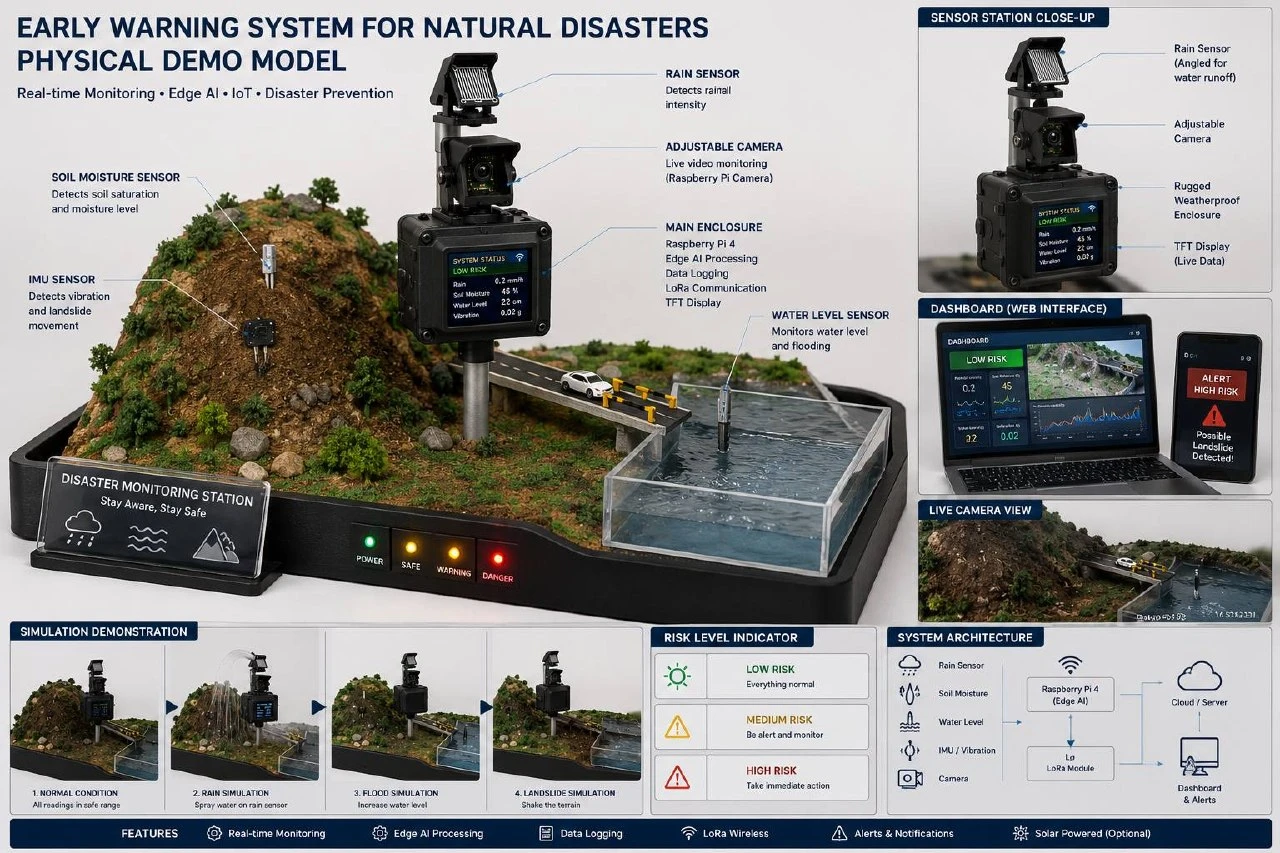
- Device: Raspberry Pi 4B with an MCP3008 ADC reading six signals: tilt and vibration (MPU6050), soil moisture, rain, water level, temperature and humidity (DHT22), plus an HD camera.
- Built for the field: 20,000 mAh battery, 3D-printed PETG-CF enclosure with IP65 sealing, and a 2.8″ colour-coded status screen. It keeps working offline.
- Backend: Supabase (Postgres) stores every reading as a telemetry packet, streams updates in real time and keeps camera photos in an evidence bucket.
- Farm dashboard (Korean): current safety status, a 5-day local forecast, live sensor values, a filterable and exportable event log, auto-captured site photos, and alert settings.
- Alerts: browser push with vibration, plus emergency contacts by SMS, KakaoTalk and email.
03 How it decides
Triple verification, three alert levels
A single wet sensor shouldn't send a farmer running. MooGuard follows a fixed pipeline, sense → verify → alert → record evidence, and combines signals so that one noisy reading can't trigger an evacuation on its own.
Ground movement (tilt) is the strongest signal of an imminent collapse, so it can raise the alarm on its own. Saturated soil only escalates to an evacuation when rain or rising water confirms it. Every state change is stored as a packet with its sensor values and a photo, ready to attach to an insurance or disaster claim.
04 Architecture
Edge first, cloud for people
- Edge decisions: detection runs on the Raspberry Pi, so the on-site screen and local alarm keep working when the network doesn't.
- Cloud for people: Supabase keeps the history, pushes live updates to the dashboard and stores evidence photos.
- Two views: the colour-coded screen on the device for the farmer in the field, and the dashboard on their phone.
05 My role
Technical lead, from sensor to screen
- Designed the overall system architecture and led the team's technical decisions.
- Wrote the device software: sensor reading, the detection thresholds and alert levels, camera capture and the status display.
- Built the backend on Supabase: telemetry storage, real-time updates, the evidence photo bucket and alert routing.
- Built the Korean farm dashboard: status, forecast, live sensors, the evidence log with export, and alert settings.
06 Business & result
Designed to be sold, not just demoed
The team planned MooGuard as a real product: a hybrid model of a hardware kit (₩450,000–700,000) plus an annual subscription (₩100,000–180,000) for small farmers, NongHyup cooperatives and local governments, with pilots in high-risk mountain counties, an IP plan, and planned PIPA, KCC and RDA compliance.
Next